Complete list
 Why Agentic AI Works Better Than Traditional Prompting?
Stop repeating prompts! Build smarter workflows that save time and effort!
“Ever felt like using AI for trading research turns into a loop?”
Ask a question → get an answer → copy something → tweak it → ask again
It helps, but it also eats up time. The more steps your research has, the messier it gets.
Quant traders spend hours refining ideas, writing repetitive code, debugging logic, and stitching everything together. Most of this effort isn’t about finding better strategies; it’s about handling the process.
In this Quantra Classroom, we explore how Agentic AI can reduce this friction by breaking work into smaller, focused steps—so you can spend less time repeating prompts and more time building and evaluating strategies.
All concepts discussed in this classroom are covered in Quantra's course “Agentic AI in Trading”. Click the View Course button to explore it further.

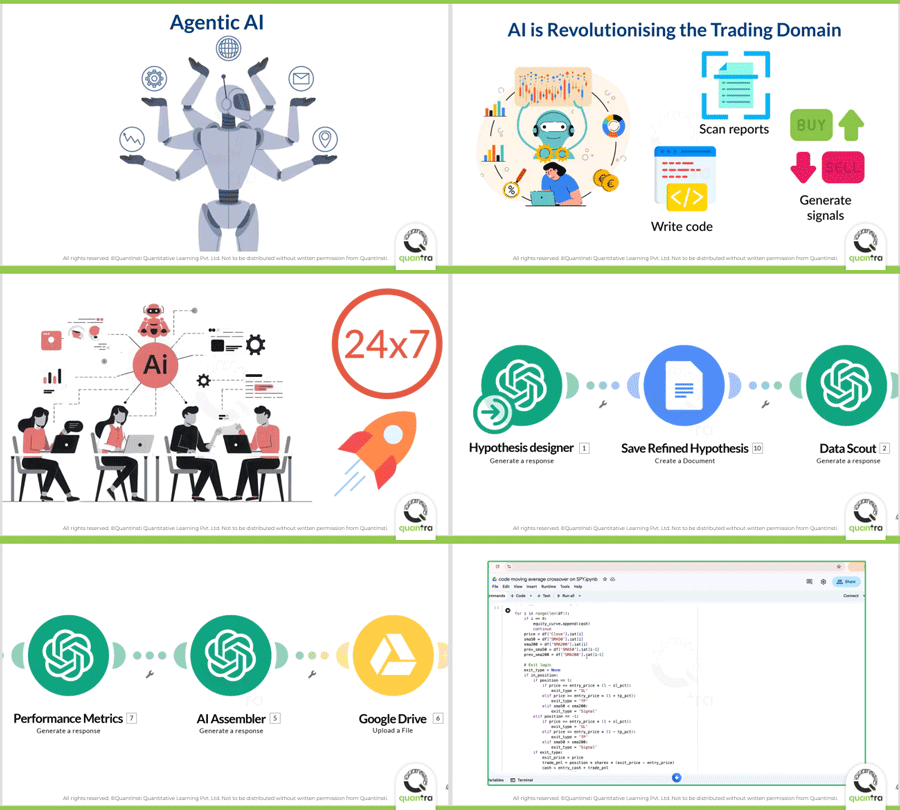
In this classroom, we’ll explore the following:
- What is Agentic AI, and why should we use Agentic AI?
- Types of Agents
- Designing an Agentic Quant Research Pipeline
- Getting Reliable Results with Agentic AI
- What’s Next in the World of Agentic AI?
What is Agentic AI, and why should we use Agentic AI?
If you’ve used LLMs to help with trading research, your workflow probably looks something like this where you ask the LLM to:
Define strategy → get code → fetch data → write backtest → analyse results → spot gaps → ask again
Doing this once is fine. Doing it for every step of research becomes tiring.
Agentic AI takes a different approach. Instead of repeatedly asking, “Can you do this next?”, agentic AI works like a team of mini-assistants, where each assistant has a clear job to do. Each agent focuses on one task, then passes its output forward. Just like how a workflow or assembly line works. You set up a workflow that already knows what comes next. The work is split into small, focused agents. Think of it like a small research team:
- One agent turns your idea into clear, defined rules
- Another fetches and prepares the data
- Another runs the backtest
- Another summarises the results
The output of one agent passes as an input for the next.
This makes research:
- Faster
- More organised
- Easier to repeat
Today, several platforms enable agentic AI workflows, such as: CrewAI, Make.com, Kiwiai, Dify etc. Each platform has its own strengths.
Types of Agents
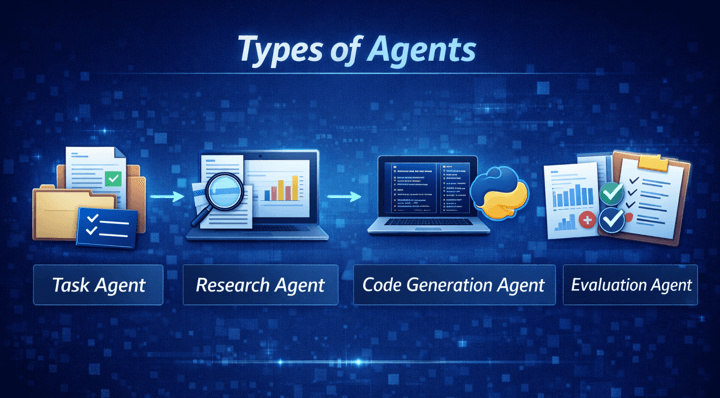
In an agentic AI workflow for trading research, different agents handle different kinds of work. Think of them as specialists, each good at one job. Here are four common types you’ll often see:
1) Task Agent
A task agent handles clear, repeatable actions. In a trading workflow, this could mean getting the data or saving a refined strategy to a document and organising outputs automatically.
2) Research Agent
A research agent gathers and summarises information. In trading, this might involve finding indicator definitions, checking common assumptions, or summarising strategy logic from a reference.
3) Code Generation Agent
A code generation agent converts a strategy idea into runnable code. This is useful when you need Python code for data preparation, backtesting, or performance metrics.
4) Evaluation Agent
An evaluation agent reviews outputs, checks for missing logic, and suggests corrections. It helps catch mistakes, inconsistencies, or gaps before you rely on the final result.
Most real workflows use a mix of these agents, working together step-by-step. In the upcoming section, we shall see how we can design a research pipeline with different types of agents.
Designing an Agentic Quant Research Pipeline
Quant research is not a single task job. It’s a chain of steps, how a quant team naturally works:
Start with a trading idea → refine it into a precise hypothesis → define indicators & rules → fetch historical data → run backtest → evaluate results
This multi-step process is where traditional repeated prompting to the LLM approach starts to feel limiting. And that’s exactly where an agentic approach becomes meaningful.
We split the work into steps and build focused agents, where each agent is doing one job well, then handing off the results cleanly to the next agent.
To keep things simple, we’ll use a basic moving average crossover strategy on SPY.
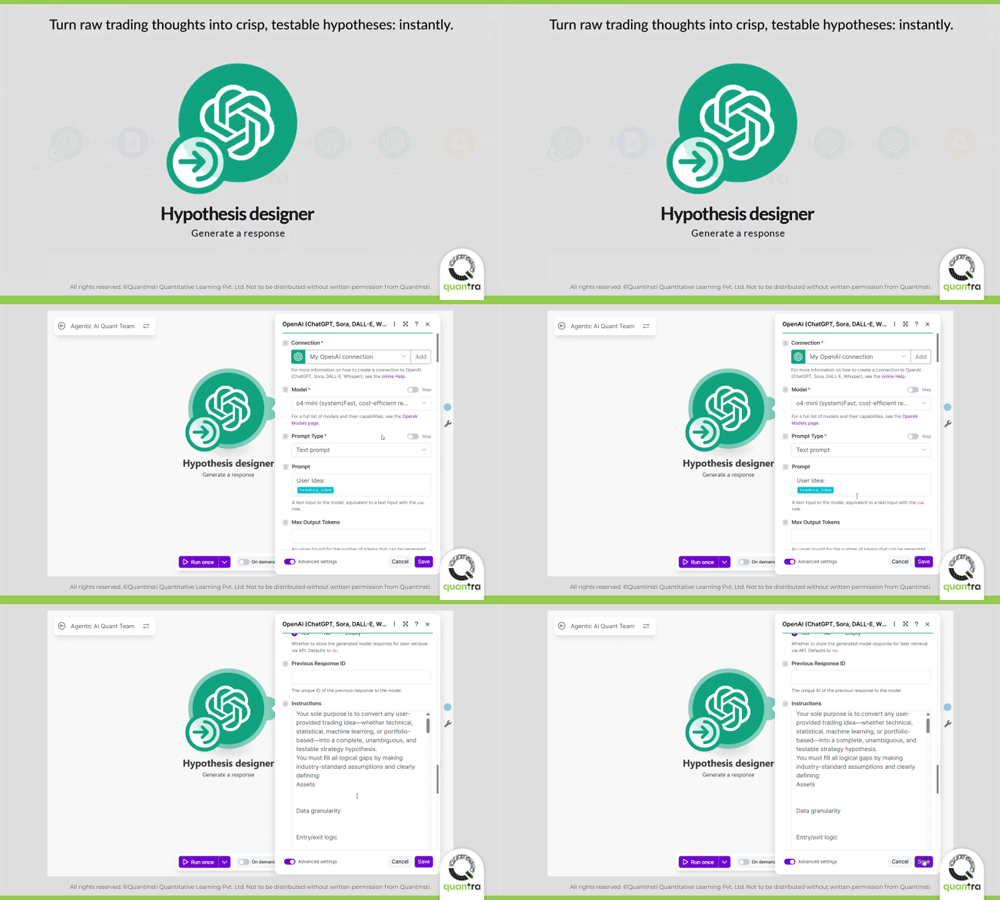
In this classroom, we have designed a simple workflow below to see how agentic AI can take a trading idea and turn it into a complete research process.
- Agent 1: Hypothesis Designer converts the idea into precise, testable rules
- Agent 2: Data Scout handles data retrieval and indicator computation
- Agent 3: Backtesting Agent simulates trades consistently over time
- Agent 4: Performance Analysis Agent evaluates results and risk metrics
- Agent 5: Notebook Assembler packages everything into a reproducible research artifact
In the next classroom, we’ll take this exact workflow and build it step-by-step in Make.com, so you can try it on your own strategies too.
If you’d like a deeper, hands-on guide to designing agentic workflows for trading research, explore Quantra’s Agentic AI in Trading course.

Getting Reliable Results with Agentic AI
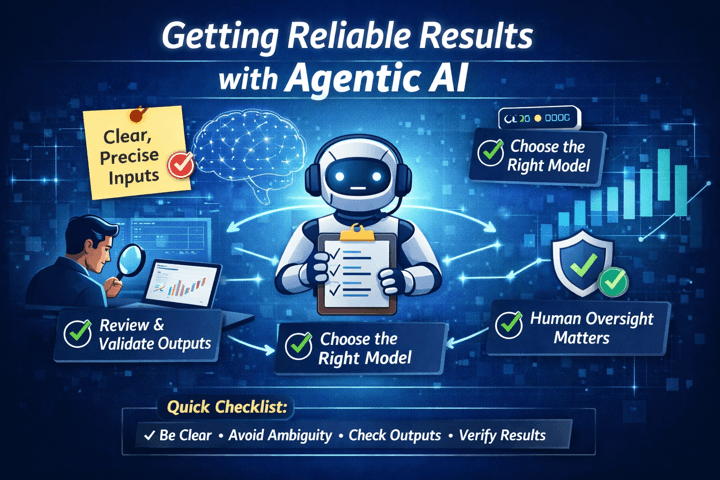
Now that we’ve seen how agentic AI breaks a big task into smaller agents, the next question is: how do we make sure the outputs are reliable?
Agentic AI can be very effective, but it works best when it is guided clearly and paired with human judgment and validation.
A few things to keep in mind:
- Vague inputs can lead to assumptions or invented logic
- The quality of results depends on how clearly agents are instructed
- Different models behave differently. Some follow instructions closely, while others are more creative
- For serious domains like trading, it’s important to review outputs before acting on them
In short, agentic AI can speed up research, but humans still need to verify the logic and results;especially in financial applications.
What’s Next in the World of Agentic AI?
In this classroom, we understood the core idea behind agentic A. Breaking a big task into smaller steps handled by specialised agents; giving structure, clarity, and better control compared to one long prompt.
But the agentic AI space is already moving ahead.
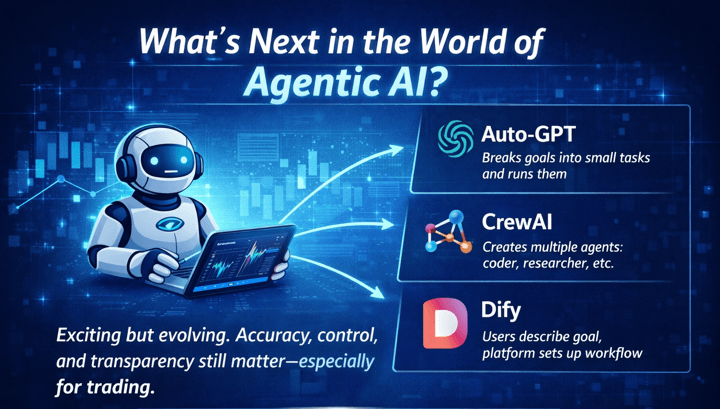
Some platforms are now trying to create and manage agents automatically, based only on the goal you describe. For example:
- Auto-GPT breaks a goal into smaller tasks and runs them on its own
- CrewAI creates multiple agents with different roles, like researcher or coder
- Platforms like Dify let you describe the goal and automatically set up the workflow
Fully autonomous agent creation is promising, but it’s still evolving. As these tools improve and add better controls, they may become more useful for systematic trading in the future.
Final Thoughts
Agentic AI doesn’t replace human thinking….it simply makes research easier by handling repeated steps in a structured way. Instead of prompting again and again, you build a workflow where each step has a clear purpose.
In this classroom, you got a simple overview of what agentic AI is, why it matters, and how it can be applied to trading research. And if you’re ready to see this in action, keep an eye out for our next classroom where we build an agentic workflow step-by-step using Make.com.
If you’d like to go deeper and learn how to design agentic workflows for real trading use-cases, explore Quantra’s Agentic AI course.