Agentic AI for Trading
₹8667 /-₹34668/-
75% OFF
Get for ₹6934 with Course Bundle
- Outcomes
- Learning Track
- Prerequisites
- Syllabus
- About author
- Testimonials
- Faqs
What You Will Learn
- Understand the foundational aspects of creating AI agents
- Analyse different methods of creating agents and user prompts
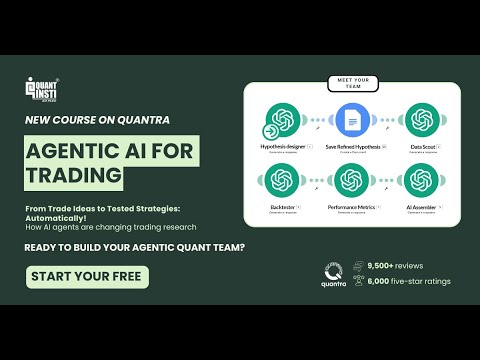
- Build a workflow of agents using low code tools for understanding user ideas and creating code for backtesting and performance analysis
- Create instant Agentic Workflows with just one prompt
- Understand the limitations of AI and how to overcome them
- Build a custom agentic AI pipeline which converts a trading idea into strategy code in minutes
Skills Covered
Agentic System Design
- Agent types and roles
- Multi-Agent Orchestration
- Prompt Engineering
Low-Code Automation & Tooling
- Make.com Proficiency
- CrewAi Studio
- Tool Integration
- Workflow Assembly
Risk Management & AI Ethics
- Identifying AI Limitations
- Implementing Guardrails
- Role of Humans in Agentic AI
THIS COURSE IS PART OF
The AI Algo Trader Bootcamp
A 4 days live, intensive bootcamp that takes you from trading intuition to AI-driven, backtested, and automated strategies using Python, Machine Learning, and brokers’ API.
Course Features
- Community
Faculty Support on Community
Interactive Coding ExercisesInteractive Coding Practice
Capstone ProjectCapstone Project Using Real Market Data
Trade & Learn TogetherTrade and Learn Together
- Get Certified
Get Certified

Prerequisites
A basic understanding of Python, along with knowledge of data manipulation using Pandas and NumPy, is essential. An understanding of how to use LLMs via their APIs is preferred, but not mandatory.
Syllabus
- Introduction to the CourseIn this introductory section, you will be able to see how you can transition from a manual debugger to a strategic architect by deploying a specialised "Agentic Quant Team" to automate your trading research.Course Introduction2mUnderstanding the Course Structure1mCourse Structure Flow Chart5mFAQs of the Course5m
- What is Agentic AI?You know why you need an Agentic AI Team, but what exactly is Agentic AI? You will finally see how an agentic AI team can work towards speeding up your idea to the alpha process. You will see how you can orchestrate a team of LLMs to autonomously plan, use tools, and execute full trading workflows.Part Overview: Introduction to Agentic AI2mWhat is Agentic AI?3mSystem Design Critique2mAgentic Planning in Real Workflows2mDesigning The Agentic Loop5mFAQs on What is Agentic AI5mSummary on What is Agentic AI5m
- Agentic AI and QuantsIs Agentic AI only a theoretical concept which is good for academic purposes only? No. You can take a look at different real-life examples of how individuals and institutions are using Agentic AIs in their processes.Agentic AI and Quants2mAgentic AI in Crypto5mBuilding Self-Correcting Agentic Workflows5mWorkflow Orchestration in Research5mDesigning Adaptive and Self-Tuning Agents5mEmbedding Constraints into Agentic Design5mAdditional Reading on Agents and Quants5mFAQs on Agentic AI and Quants5mSummary on Agentic AI and Quants5mTest on Understanding Need and Working of Agentic AI22m
Types of Agents
In this section, you will be able to classify agents based on the type of tasks they are created for, which are Task, Research, Code-Generation, and Correction agents.Part Overview: Foundation of Agentic AI2mTypes of Agents2mApplication of Agent Functionality5mDesigning a Custom Agentic Workflow5mExtending Agent Roles for Collaboration5mCustomising Agentic Pipelines5mRole Separation5mFAQs on Types of Agents5mAdditional Reading on Types of Agents5mSummary on Types of Agents5m- Art of PromptingCan you communicate with an agent in plain English? Yes and No. While humans have evolved to incorporate context, past experiences and plain common sense when they are performing a task, an agent does not. This is why you should know how to instruct in clear language, which is where prompt creation comes in.Art of Prompting2mComponents of a Good Prompt5mContext and Rules5mOvercoming Vagueness5mFormat Issue5mUsing Structured Prompts5mPrompt Engineering for Autonomy5mFAQs on Prompting5mSummary on Prompting5mTest on Foundations of AI12m
Introduction to Agentic AI Trading Workflows
This section introduces the concept of Agentic AI workflows in trading and how multiple specialised agents work together to automate research. You’ll also explore the key tools and platforms used to build agentic workflows, from no-code to low-code and code-first approaches.Building Agentic AI Trading Workflows2mTools For Creating Agents2mTool Trade-Offs2mPurpose of No-Code Tools2mLow-Code in Data Pipelines2mSelecting Tools Based on Project Needs2mChoosing Tools Based on Workflow Needs2mAdditional Reading on Introduction to Agentic AI Trading Workflows5mFAQs on Introduction to Agentic AI Trading Workflows5mSummary on Introduction to Agentic AI Trading Workflows5mAgent 1 - Hypothesis Designer
In this section, you’ll learn why trading ideas need to be formalised before backtesting and how the Hypothesis Designer Agent converts rough ideas into structured, testable strategies. You’ll then build its rulebook and implement the agent step-by-step in Make.Part Overview of The Build Roadmap2mHypothesis Designer Agent2mGap Between Idea and Hypothesis2mBuilding Rulebook For Hypothesis Designer Agent2mJudging the Completeness of Output2mDesigning Rulebooks for Agent Behavior2mRulebook Assumption Defaults2mFour Pillars of the Rulebook2mHypothesis Designer Agent In Make2mCorrect Setup of Modules in Make2mUnderstanding Output Structure2mModel Selection Criteria2mFAQs on Agent 1- Hypothesis Designer5mAdditional Reading on Agent 1- Hypothesis Designer5mSummary on Agent 1- Hypothesis Designer5mRulebook for Agent 15m- Agent 2 - Data ScoutThis section focuses on the Data Scout Agent, which transforms strategy hypotheses into backtest-ready data. You’ll understand why consistent data preparation matters, design the agent’s rulebook, and build it in Make to automatically generate Python data pipelines.Data Scout2mOutput Rules2mInstructions Usage2mDesigning Rulebook2mAssessing Rule Adherence and Workflow Outcomes2mData Scout in Make2mInterpreting Automation Workflow2mSequential Dependency2mPrompt Mapping Logic2mData Flow Between Agent's2mPerformance Tuning2mFAQs on Agent 2- Data Scout5mRulebook for Agent 25mSummary on Agent 2- Data Scout5m
- Agent 3 - BacktesterIn this section, you’ll build the Backtester Agent that simulates trades by applying strategy rules to historical data. You’ll design its execution rulebook and implement the agent in Make to automatically generate backtest simulation code.Backtester Agent2mWriting Rulebook2mCompleteness of Backtest Code2mCode-writing Role of Backtester2mStructured Hypothesis in Backtest Code2mBuild Backtester in Make2mChecking Successful Execution2mPurpose of Setting Reasoning Effort2mInput Orchestration2mOutput Verification and Chaining2mSequential Dependency2mMulti-Module Input Mapping2mFAQs on Agent 3- Backtester5mSummary on Agent 3- Backtester5mRulebook for Agent 35mFrom Idea to Backtest14m
- Agent 4 - Performance MetricThis section introduces the Performance Metric Agent, which evaluates backtest results and converts raw outputs into meaningful performance insights. You’ll design its rulebook and build the agent in Make to generate professional metrics and visualisations automatically.Performance Metric2mImportance of Visualisations2mRisk-Reward Contextualisation2mLogic Modularisation2mDesigning New Visualisation Rule2mBuild Performance Metric Agent in Make2mSuccessful Agent Execution2mReasoning Effort2mTechnical Mapping in Make2mOutput Rule Enforcement2mFAQs on Agent 4- Performance Metric2mSummary on Agent 4- Performance Metric5mRulebook for Agent 45m
- Agent 5 - AI AssemblerIn this section, you’ll build the AI Assembler Agent, which brings together all strategy components into a single, clean Jupyter Notebook. You’ll design its rulebook and implement the agent in Make to automatically generate a complete, end-to-end research Python notebook.AI Assembler5mAssembly Flow and Output2mNotebook Structure2mExtending Notebook Structure2mFunctional Identity2mStructure and Standards2mExecution and Input Mapping2mAI Assembler in Make2mReasoning for Drive Saving2mTroubleshooting and Debugging2mVerification of Chain Success2mFAQs on Agent 5- AI Assembler5mSummary on Agent 5- AI Assembler5mRulebook for Agent 55m
- Customising the Agentic AI Trading WorkflowsThis section shows how to adapt and extend your Agentic trading workflow for different research needs. You’ll learn how to modify inputs, swap AI models, and reshape outputs to create flexible, reusable quant research pipelines.Customising Agentic Workflows3mNature of Agentic Workflow2mCustomising Input Formats2mSwapping AI Models2mDesigning New Workflow Variants2mModel Interoperability2mAdditional Reading on Customising the Agentic AI Trading Workflows5mFAQs on Customising the Agentic AI Trading Workflows5mSummary on Customising the Agentic AI Trading Workflows5m
- Instant Architectures with CrewAI StudioIn this section, you’ll explore CrewAI Studio as a fast alternative for creating agentic quant teams without manual setup. You’ll see how instant multi-agent architectures can be generated from a single prompt for quick idea screening and rapid experimentation.Part Overview on Instant Architectures with CrewAi Studio1mInstant Agentic Quant Teams with CrewAI Studio4mFast Estimates vs Structured Control2mTradeoffs Between Outputs2mPrompt Design for Output Variation2mError Interpretation2mTransparency & Debugging2mFAQs on Instant Architectures with CrewAI Studio5mAdditional Reading on Instant Architectures with CrewAI Studio5mSummary on Instant Architectures with CrewAI Studio5mFrom Backtest to Scalable Research12m
- Three Sins of AI in Quant TradingIs AI perfect? No. Find out the limitations of AI, which can be categorised as hallucination, data snooping bias, and overfitting.Part Overview: Limitations of AI in Quant Trading2mThree Sins of AI in Quant Trading2mToo Good to Be True5mRole of Human in Agentic AI5mRobustness and Perfection5mDesigning Role of Human in Agentic AI5mFAQs on Three Sins of AI in Quant Trading2mSummary on Three Sins of AI in Quant Trading2m
- Overcoming Limitations of AI in Quant TradingHow do you overcome the limitations of AI? By building guardrails to make sure that your AI agents are performing as they are told. In this section, you will see how to build a robust Safety Loop that acts as an autonomous risk manager for your AI quant team.Overcoming Limitations of AI in Quant Trading2mOvercoming Prompt Injection5mDesigning Sandbox for AI tool Access5mImplementation of Anomaly Detection5mDesigning Permission Guardrails5mFAQs on Overcoming Limitations of AI in Quant Trading2mSummary on Overcoming Limitations of AI in Quant Trading2mTest on Overcoming Limitations of AI10m
- Capstone ProjectApply everything you’ve learned to build a multi-strategy agentic quant workflow that processes multiple trading ideas in one run. The final output is a single Jupyter Notebook with backtests and performance analysis for all strategies.Getting Started5mProblem Statement5mCapstone Solution5m
- Summary of the CourseRecap your complete journey, from the need for agentic AI to building your own Agentic AI Quant Team.Summary of the Course2mSummary and Next Steps2m
Registered Successfully!
You will receive webinar joining details on your registered email
Would you like to start learning immediately?
about author

Why quantra®?
- More in Less Time
Gain more in less time
- Expert Faculty
Get taught by practitioners
- Self-paced
Learn at your own pace
- Data & Strategy Models
Get data & strategy models to practice on your own

Reviews
- 6000+5 Star Ratings
- 6400+Reviews from APAC Region
- 1700+Reviews from EMEA region
- 1500+Reviews from North & South America
- Jackie Pineda

EDI Specialist,United States
Fantastic course. Really enjoyed build my own agentic quant team and already have plans to expand. - Paolo Mammola

United Kingdom
Good course overall - Michael Horn
Germany
The courses on Quantra are quite structured, with theory as well as practical hands-on Python experience. The delivery of content was very smooth. What I liked the most is that the courses taught concepts of mathematics and quantitative model using Python scripts so well! It was also reassuring that I could ask any doubts I had on the community platform. I'm looking forward to completing more courses on the platform, one at a time. - Artur B
Mechanical Engineer Professor,Portugal
After four years on the Quantra platform and having taken over 20 courses, I must say that the entire learning experience has been transformative. I find that the courses that I took, are very well organized, present relevant information on the subject and in fact, you can make your changes and it allows you to Implement the things in your way. For me these courses provide the starting points - a point from which you can do your own work. I appreciate that Quantra allows learners to retake courses multiple times—this has been incredibly useful for revisiting and brushing up on key concepts.
Faqs
- When will I have access to the course content, including videos and strategies?
You will gain access to the entire course content including videos and strategies, as soon as you complete the payment and successfully enroll in the course.
- Will I get a certificate at the completion of the course?
Yes, you will be awarded with a certification from QuantInsti after successfully completing the online learning units.
- Are there any webinars, live or classroom sessions available in the course?
No, there are no live or classroom sessions in the course. You can ask your queries on community and get responses from fellow learners and faculty members.
- Is there any support available after I purchase the course?
Yes, you can ask your queries related to the course on the community: https://quantra.quantinsti.com/community
- What are the system requirements to do this course?
Fast-speed internet connection and a browser application are required for this course. For best experience, use Chrome.
- What is the admission criteria?
There is no admission criterion. You are recommended to go through the prerequisites section and be aware of skill sets gained and required to learn most from the course.
- Is there a refund available?
We respect your time, and hence, we offer concise but effective short-term courses created under professional guidance. We try to offer the most value within the shortest time. There are a few courses on Quantra which are free of cost. Please check the price of the course before enrolling in it. Once a purchase is made, we offer complete course content. For paid courses, we follow a 'no refund' policy.
- Is the course downloadable?
Some of the course material is downloadable such as Python notebooks with strategy codes. We also guide you how to use these codes on your own system to practice further.
- Can the python strategies provided in the course be immediately used for trading?
We focus on teaching these quantitative and machine learning techniques and how learners can use them for developing their own strategies. You may or may not be able to directly use them in your own system. Please do note that we are not advising or offering any trading/investment services. The strategies are used for learning & understanding purposes and we don't take any responsibility for the performance or any profit or losses that using these techniques results in.
- I want to develop my own algorithmic trading strategy. Can I use a Quantra course notebook for the same?
Quantra environment is a zero-installation solution to get beginners to start off with coding in Python. While learning you won't have to download or install anything! However, if you wish to later implement the learning on your system, you can definitely do that. All the notebooks in the Quantra portal are available for download at the end of each course and they can be run in the local system just the same as they run in the portal. The user can modify/tweak/rework all such code files as per his need. We encourage you to implement different concepts learnt from different learning tracks into your trading strategy to make it more suited to the real-world scenario.
- If I plug in the Quantra code to my trading system, am I sure to make money?
No. We provide you guidance on how to create strategy using different techniques and indicators, but no strategy is plug and play. A lot of effort is required to backtest any strategy, after which we fine-tune the strategy parameters and see the performance on paper trading before we finally implement the live execution of trades.
- What does "lifetime access" mean?
Lifetime access means that once you enroll in the course, you will have unlimited access to all course materials, including videos, resources, readings, and other learning materials for as long as the course remains available online. There are no time limits or expiration dates on your access, allowing you to learn at your own pace and revisit the content whenever you need it, even after you've completed the course. It's important to note that "lifetime" refers to the lifetime of the course itself—if the platform or course is discontinued for any reason, we will inform you in advance. This will allow you enough time to download or access any course materials you need for future use.
- Who is this course for?
This course is for traders, analysts, or students who want to use modern AI to automate the research and strategy development process. It focuses on practical implementation using no-code and low-code tools.
- What is Agentic AI for Trading?
Agentic AI refers to a system where AI "agents" are given the autonomy to use tools, reason through complex problems, and take actions to achieve a specific goal. In the context of trading, this means moving beyond simple predictive models to a system that can independently research hypotheses, fetch data, run backtests, and evaluate performance without constant human intervention.
- How is Agentic AI different from using a single AI model?
While a single AI model (like a standard LLM) can answer questions or provide code for predicting a price move, it requires repeated prompting. Agentic AI operates as a coordinated team, with different "specialists". For example, one agent will focus on data retrieval and performing checks on data, while another agent focuses on backtest code.
- If backtesting engines already exist, why develop a new backtester?
There are indeed several robust and well-established backtesting engines available, and rebuilding the mathematical logic of a backtester from scratch is often unnecessary.
The purpose of this course is not to create a new calculation engine, but to automate the workflow of a Quantitative Researcher.
Why this course still matters:
-
Solves the idea-to-code bottleneck:
Even with existing backtesters, trading ideas must be manually translated into Python code, data must be prepared, and errors must be debugged. This course teaches you to build agentic workflows that convert a plain-English trading idea directly into a complete, executable backtesting script. -
Focuses on orchestration, not just coding:
You learn to design and manage multiple AI agents that handle strategy formalization, data sourcing, backtesting, and notebook assembly, similar to how a real research team operates.
Agent 1 (Hypothesis): Formalizes the strategy.
Agent 2 (Data Scout): Finds & preps the data.
Agent 3 (The Backtester): Writes the simulation code.
Agent 4 (Assembler): Compiles it all into a Jupyter Notebook.
You become the manager of an AI team that does the heavy lifting, allowing you to test multiple ideas in the time it used to take to test one.
-
Builds future-proof skills:
The concepts you learn, multi-agent orchestration and tool-using AI, are transferable beyond backtesting and can later be applied to live execution or risk management workflows.
In short: you’re not learning to build a backtester, you’re learning to automate quantitative research.
-
- Is this course suitable for beginners?
Yes. The curriculum is designed in such a that beginners can understand the concepts clearly before moving to implementation.
- Do I need advanced Python knowledge to take this course?
While the course covers technical implementation, it does not require advanced python knowledge, though a basic understanding of Python will be helpful when you are looking at the generated code of the agents.
- What will I build in this course?
You will build a comprehensive Agentic Quant Team. This includes:
- Hypothesis Designer Agent: To convert vague ideas to structured hypothesis.
- Data Scout Agent: To find and prepare market data.
- Backtester Agent: To simulate your strategies.
- Performance Evaluation Agent: To analyse results.
- AI Assembler Agent: To coordinate the entire system